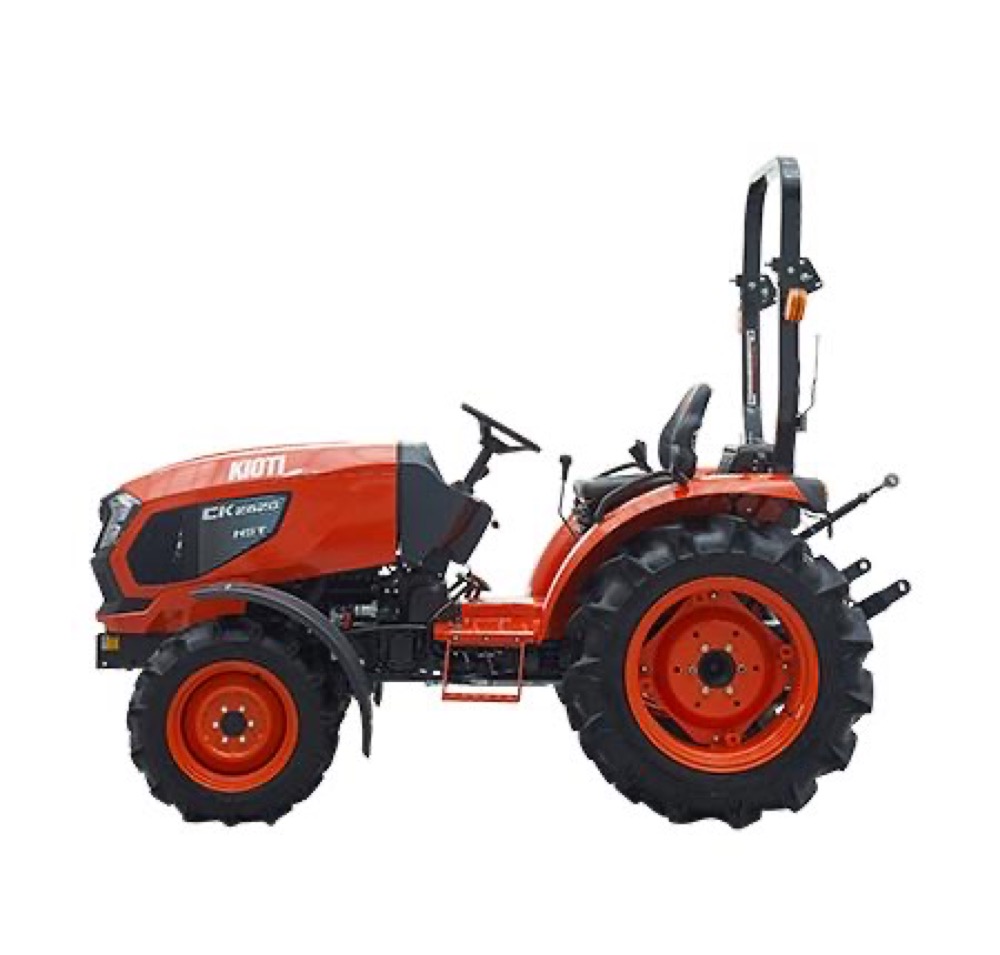
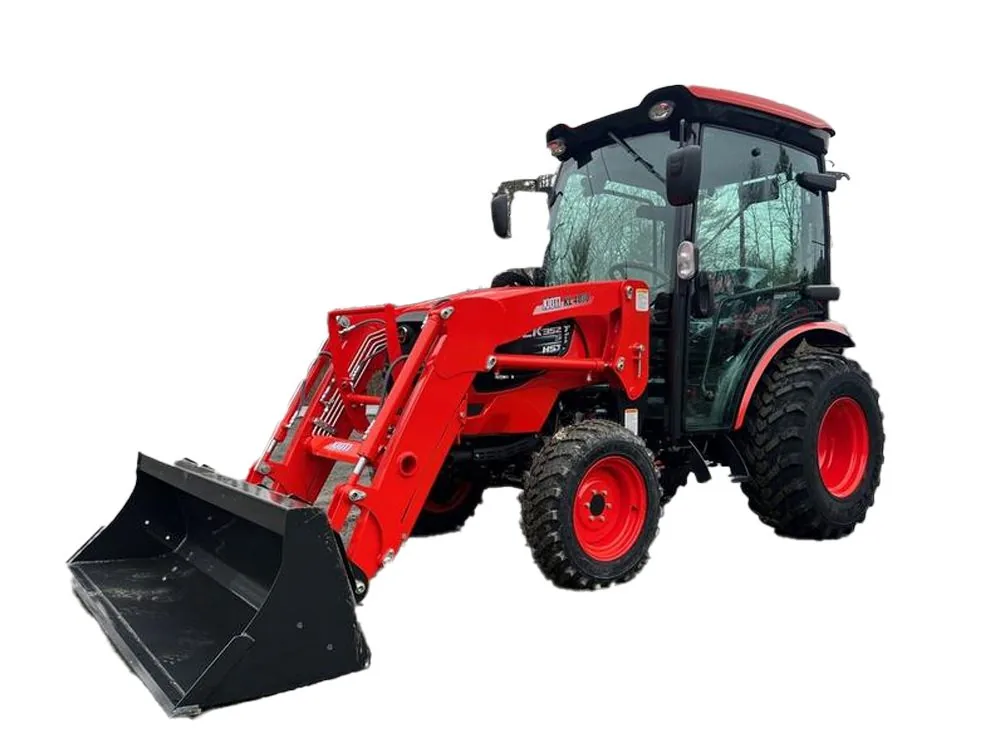
Almost everyone who ends up on a CK2620 arrived from a Kubota quote. Owners describe walking into a dealership for an L2501, L2502 or LX2620, measuring it against what they actually need to pick up — 800 to 1,200 lb oak logs, a grapple, a rock bucket — and finding the Kubota loader short of the number. One shopper put the Kioti's usable lift at about 1,800 lb against an L2502's 1,144 and said the lift capacity alone would have decided it. What they do not agree on is the price gap: one buyer found an LX2620SU and an L2501 quoted within $1,000 of the CK2620, while another walked out of a Kubota dealer marking up 10% over its own build price and bought the Kioti for $10,000 less. The gap is a dealer fact, not a brand fact.
In use the recurring word is workhorse, with caveats. Owners at 160 to 180 hours describe it as trouble-free while running bush hogs, backhoes and box blades, and it swings a 5-foot or 60-inch rotary cutter in three-foot grass in mid range without bogging. Two separate owners had a hydraulic leak at the rear remotes within days of delivery, both fixed at home under warranty. The range lever is stiff enough getting from neutral into gear that owners have a shared workaround — bump the forward or reverse pedal slightly and it drops in. Open-station machines are loud; one owner cannot hold a conversation with his wife while working and is shopping for a muffler.
The less obvious thing about this tractor is that its 24.5 hp rating is deliberate. Owners describe a larger engine held down to stay under the emissions threshold, which is precisely why they bought it — the machine they wanted was the one that arrives without diesel exhaust fluid and a particulate filter to manage. (Owners also swap notes on uncapping the injection pump for more power, which belongs to an earlier, mechanically injected generation; Kioti fits a common-rail engine here.) It suits someone on five to fifteen acres who wants compact-frame lift without DEF or a particulate filter, and who accepts the standing caution owners repeat to each other: it is a small tractor, it does small-tractor things well, and it does big-tractor things slowly. One owner on flat ground says he would buy 60 hp next time, mostly because every good used implement he finds is too big for it.
Does the CK2620 actually undercut a Kubota L2501 or LX2620?+−
That depends entirely on which dealers you visit. One shopper was surprised to find an LX2620SU and a used L2501 quoted within $1,000 of the CK2620. Another found his Kubota dealer pricing about 10% over Kubota's own build figure, with a backhoe marked up nearly 30%, and bought the Kioti for $10,000 less. Treat the price advantage as something to go and verify with quotes, not as a given.
Does the CK2620 need DEF or have a particulate filter to manage?+−
No. At 24.5 hp it sits under the threshold that brings diesel exhaust fluid and a particulate filter, and owners repeatedly name that as the reason they stopped at this rating rather than moving up the range. Kioti fits a common-rail Tier 4 engine here, so the quieter running and the fuel figures owners report come from injection control rather than from any aftertreatment being absent.
Why is it so hard to get into gear?+−
This catches buyers on test drives. The range lever can be stiff going from neutral into low, and the shared fix among owners is to bump the forward or reverse pedal a fraction, which lets it drop in without fighting it. Dealers say it eases with use and owners who have put hours on one agree it does. If it will not go in at all, that is a different problem, but the stiffness itself is normal for the model.
Do I need loaded tires or a ballast box?+−
Yes, and more than the numbers suggest. One owner with rear tires filled with Rim Guard and a backhoe mounted still lifts the rear tires when he picks up something heavy up front, and says he would hate to try it unballasted. Owners who run a box blade on the back for loader work consider that sufficient ballast for bucket and gravel duty; fluid-filled tires also lower the centre of gravity, which several owners credit for saving them on uneven ground.
Is the cab worth roughly $10,000 on a tractor this size?+−
Cab owners in the evidence are unanimous that it was, and the reasons go beyond winter — dust, sun, pollen and biting insects in woods work come up as often as snow. Owners plowing five or six inches report being comfortable enough to open a window. The dissenting case comes from an owner who took a backhoe instead and is glad of the visibility and of not worrying about breaking glass in the trees, though he still plans to fit an aftermarket cab with a heater.
What jobs will it not do?+−
Owners are blunt that it is a small tractor: it does small-tractor work well and big-tractor work slowly, in smaller bites. A heavy 5-foot cutter makes it pause to recover engine speed when the PTO engages, and you need to be quick on the 3-point if it starts to bog. On steep ground a tracked machine is simply safer. One owner on flat land says the real limit he hit was the used-implement market — everything worth buying secondhand was too big for the tractor.
Summarised from public owner discussion, not from testing. Nothing here was measured by this site, and a report that recurs is not the same as a defect rate.