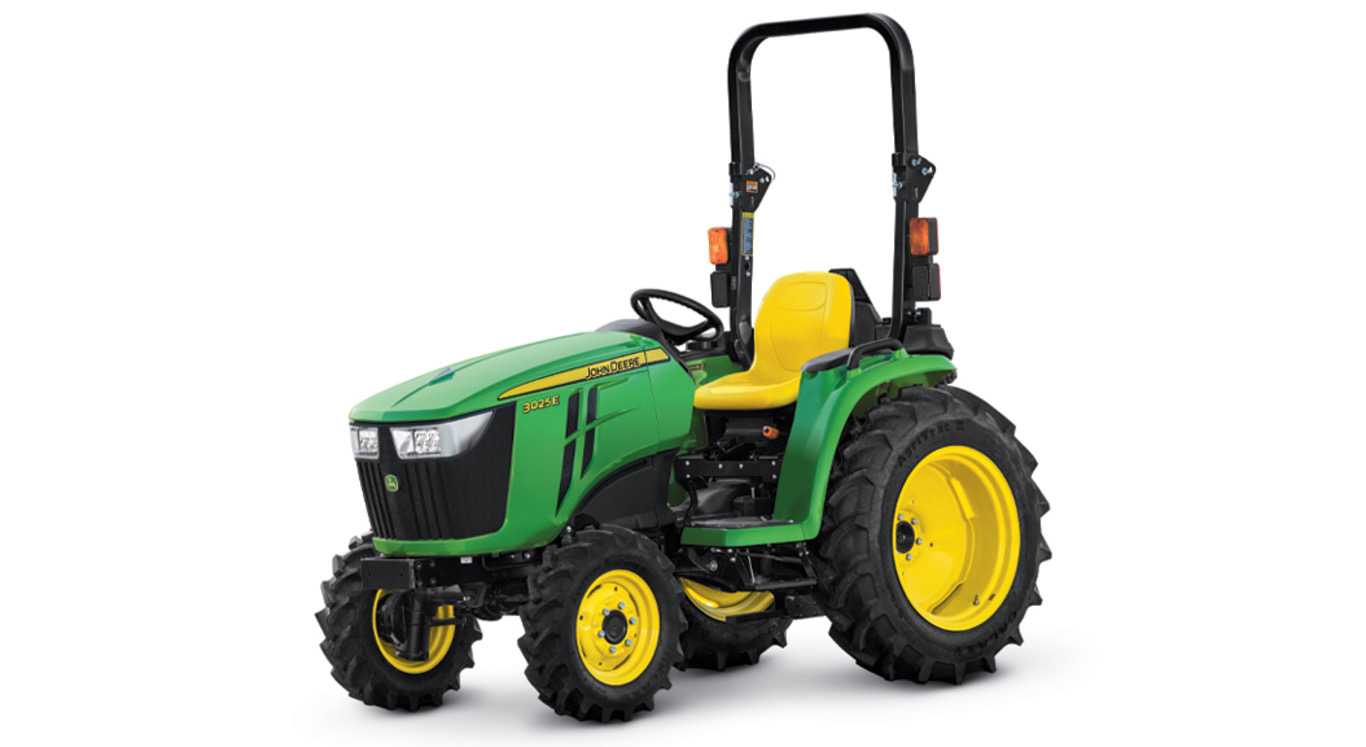
When people describe why they bought a 3025E rather than something smaller, the phrase that recurs is more steel — more frame, more weight, wider stance, no DEF and no particulate filter — rather than more power. Owners on two to six acres are the most enthusiastic voices in the file: one has used his multiple times a month for seven years plowing snow, grading a driveway, running a chipper, moving trees with a grapple and expanding his lawn, and says he cannot imagine the place without it. Another on 2.5 acres in New Hampshire says he would not touch anything smaller and that his only real regret was not buying a root grapple first. It is also priced well against rivals despite the badge: owners note a Deere filter kit runs about $150 against roughly $130 for the Kubota equivalent, which is more but not the gulf people expect.
The complaint cluster is hydraulic, and it is consistent enough to shop around. Owners report loaders that will not hold a raised bucket overnight, buckets that go loose or wobbly a minute after being pinned up and need re-curling, an SCV that failed within an hour of delivery with the boom drifting about an inch a second, and air working its way into the curl cylinders repeatedly. One owner's dealer attributed that air to using the high-speed dump position and called it normal per a factory bulletin, which the owner did not accept. The most useful explanation comes from an owner who put 400 hours on one and asked Deere mechanics directly: the E is not the premium model, so the system is built with some play in it — which is also why the loader arms do not move evenly when you are lining up an attachment. Owners also warn there are no factory rear remotes, so a third-function or rear valve is an aftermarket purchase, and the loader uses Deere's own coupler rather than a skid-steer one.
Electrical faults show up often enough to mention alongside: starter relay faults after a winter sitting, an EGR-circuit code on a machine with 30 hours that halved its power, a stalling fault after one to three hours of running, and one owner whose machine repeatedly went completely dead and stayed unsolved through a new battery, a new ECM and a hired mechanic. Against that, several owners report four to seven years with nothing needing a dealer at all. On capability, the honest limits owners describe are power rather than frame: a rotary cutter bogs in thicker grass, hilly ground is a fight uphill, and the machine has no mid-PTO, so a belly mower is not an option and a separate rider or a rear finish mower is part of the plan.
How many acres does a 3025E suit?+−
Owners are happiest in roughly the two-to-six-acre range doing mixed property work — snow, driveway grading, grapple and brush work, landscaping — and several at the small end say they would not go any smaller. Above that the limit owners report is power rather than frame: one who bought one when he bought his farm found the lift short and the rotary cutter bogging in thick grass, and sold at 605 hours for something larger.
What are the known problems to check on one?+−
Hydraulics first: a bucket that will not stay raised after shutdown, a load that goes loose a minute after being pinned up, or air recurring in the curl cylinders. Owners have been told by mechanics that a degree of play is designed into the E's system, which also shows up as the loader arms rising unevenly. Second, look for electrical faults — starter relay codes, EGR-circuit codes, and intermittent stalling all appear on different machines.
Can I finish-mow my lawn with a 3025E?+−
Not with a belly deck — there is no mid-PTO, so the options are a rear-mounted finish mower or keeping a separate machine. Owners who have compared directly say a garden tractor is simply the better mower: faster, lighter and easier on your back over a long day. Taking the loader off to mow and putting it back on is something owners describe as not worth attempting.
Does it have rear hydraulic remotes?+−
No, and this catches buyers out. Owners discover after purchase that there are no factory rear hydraulics, so a third function for a grapple or a rear remote means an aftermarket electric valve kit. Owners pricing the grapple and the valve together describe it as another four thousand dollars or so, which is worth knowing before you commit to a bare loader package.
Is the Deere premium over a Kubota or Kioti real?+−
Less than the reputation suggests on parts, more on service attitude. One owner priced the filter kits directly and found about $150 for the Deere against roughly $130 for the Kubota equivalent — more, but not prohibitive. Where owners do split is support: some have a dealer within fifteen minutes and no complaints, others describe Deere's repair policy and service posture as the reason they bought orange instead. The consistent advice is to choose on which dealer will actually look after you.
Does it have a DPF or need DEF?+−
Neither. It sits under the threshold, and owners recommending it to first-time buyers consistently put that at the top of the list — the pitch is a heavier frame and wider stance without the emissions plumbing. Owners describe these compacts as having very little in the way of computers, which is part of why several say they intend to keep them a long time.
Summarised from public owner discussion, not from testing. Nothing here was measured by this site, and a report that recurs is not the same as a defect rate.