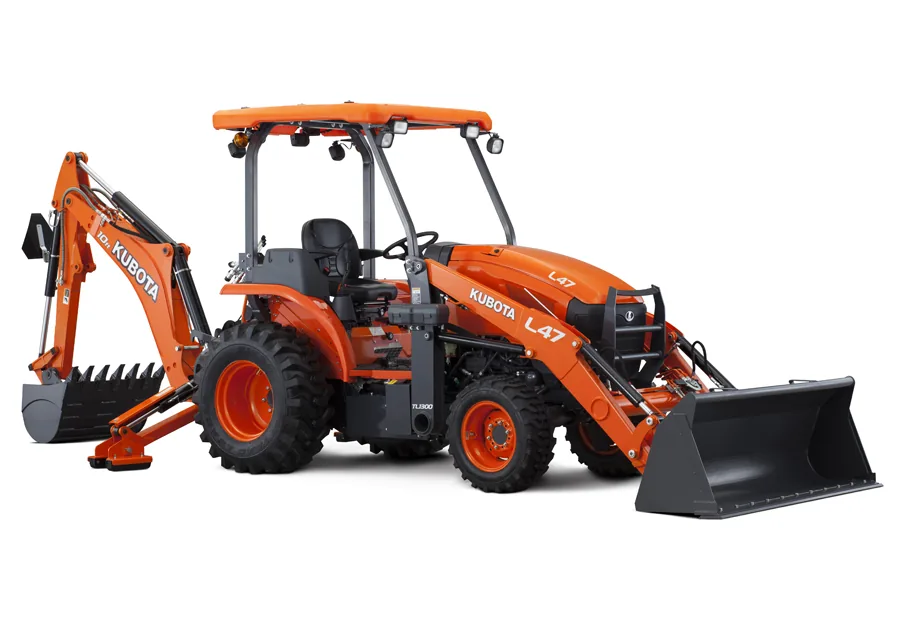
The most useful account here comes from an owner four years in, and his conclusion is blunt: this machine shines with the backhoe on, and with a mower fitted instead it is just a very expensive L-series that cannot lift as much as it should. If he bought again he would skip the mower entirely and pay someone to cut the grass once a year, leaving the hoe on permanently. He also corrects the widespread belief that a dedicated loader-backhoe is welded together - the backhoe comes off with two pins and nothing else, about thirty minutes to change over to the mower, and bucket swaps take one pin. What makes the hoe genuinely better than a three-point attachment, in his telling, is not size but control: the crawl function, the sideways-facing controls and the thumb. Mechanically he reports four years without a single fault beyond things he caused himself, like knocking a taillight off on blackberry bushes.
Where owners are consistent, and worth listening to before spending this much, is that a four-ton machine is not an excavator and they keep buying one anyway. An owner with two of these calls them tanks for their weight class and says in the same breath that he bought a mini excavator for digging. Another warns that for paid trenching a mini excavator makes more sense, because although this is manoeuvrable you reposition constantly where a tracked machine would simply pivot and keep going. A third went from a B26 to an L39 and an L47 and is now, in his words, on the excavator path. The counterpoint is reach and stability: owners moving big rocks and trees say the extra weight and much longer dipper over a B26 is a substantial help, and one who had experience of an L47 says it lifted far more than he expected.
The practical ownership notes cluster around traction and the options list. These come on R4 tires that owners describe as notoriously poor on ice, and the fix owners agree on is chains plus wheel spacers, which one says made a world of difference pushing a 6-foot blade up and down a very steep paved driveway - though real chains tear up asphalt badly, so he switched to rubber chains and found the traction loss negligible. On options, the recommendations are a third function for the loader, triple three-point remotes, extendable rear links and a hydraulic thumb, plus Kubota's quick-attach setup that lets mini-excavator buckets fit the backhoe and broaden what you can dig with. The regret one owner names is skipping the hydraulic quick-attach latches, which he thinks about every time he swaps bucket to forks for the fourth or fifth time in a day.
Does the backhoe actually come off, and can it do normal tractor work?+−
Yes, and this gets answered wrongly a lot. An owner four years in reports the backhoe releasing with two pins and nothing more, taking roughly thirty minutes to change over to a mower, with bucket swaps needing a single pin. His advice, though, is not to bother: with a mower fitted the machine becomes an expensive L-series that cannot lift as much, so he would keep the hoe on permanently and pay someone to cut the grass once a year.
Should I buy this or a compact tractor plus a rented mini excavator?+−
If digging is your business, owners lean towards the excavator. One who runs two frame-mounted Kubota backhoes bought a mini excavator for digging regardless, and another points out that for trenching you reposition this machine constantly where a tracked machine pivots and keeps working. Where this wins is being one machine that drives itself between jobs at road speed, loads, and does not tear up a customer's field the way tracks can - one owner says if you can only have one machine, this is the one.
How does it compare with a B26?+−
An owner who demonstrated both before buying chose this one, and his reasons were reach and convenience: the B26 fell short on both loader height and backhoe dipper reach, and he found swapping the seat between stations an aggravation. Owners moving heavy rock and trees agree the extra weight and longer reach matter. The B26 wins on price, on lower ground compaction, on being towable by less truck, and on staying under the emissions threshold, which one buyer found genuinely tempting.
What will tow an L47?+−
A 22-foot trailer works, with an owner suggesting 22 to 24 feet so you can position the weight properly, and a modern three-quarter-ton truck handles it without difficulty. The same owner has moved his short distances behind a half-ton but says it is too much truck for that, so treat a half-ton as an emergency measure rather than a plan.
Which options should I order with it?+−
Owners consistently name a third function for the loader and triple three-point remotes, with two sets of rear remotes if you want top-and-tilt, plus extendable rear links and a hydraulic thumb. Kubota's quick-attach setup for the backhoe is worth asking about because it lets you fit buckets from the mini-excavator range and widen what you can dig. The regret one owner names is skipping the hydraulic quick-attach latches, which he reconsiders every time he changes bucket to forks four or five times in a day.
Summarised from public owner discussion, not from testing. Nothing here was measured by this site, and a report that recurs is not the same as a defect rate.