John Deere · Sub-Compact

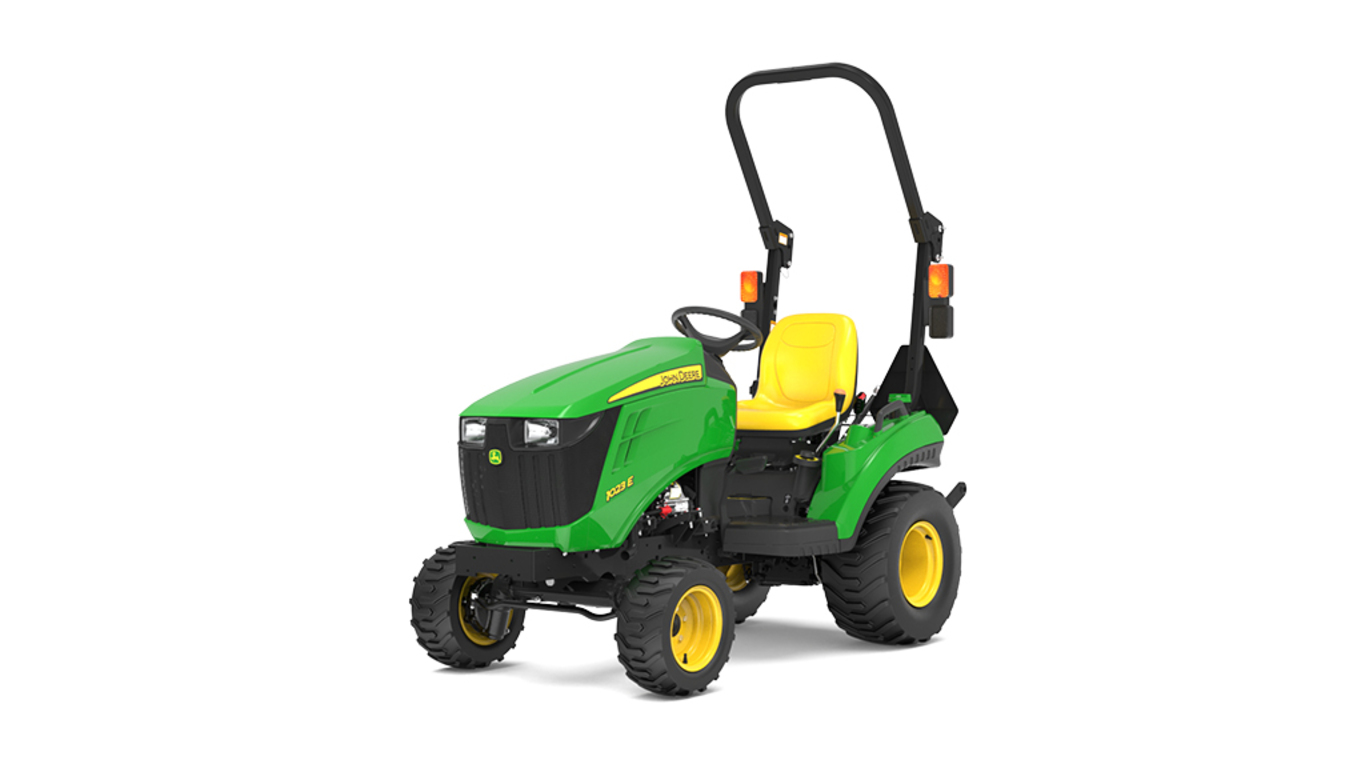
John Deere 1023E

~$15,759

MSRP, base build

No longer in production

No longer built. The maker sells the John Deere 1E 23 in its place. See the John Deere 1E 23 The specs and owner reports below still describe this machine, and used ones trade steadily — but a dealer cannot order you a new one.

John Deere 1023E
Sub-Compact
21.5 hp engine · 15.3 PTO−29% to the shaft

Deere's price of entry: the same 1-Series frame and 120R loader mounts as the 1025R, minus cruise control, the independent PTO and about three thousand dollars. Carried into 2026 as the 1E 23, so the old badge is now mostly a used-lot search term.

Engine
21.5 hp
PTO
15.3 hp
Loader lift
836 lbs
3-pt lift
681 lbs

0.97 PTO hp per $1,000 of list price

As published by the maker

Specifications

Size class
Sub-Compact
Transmission
Hydrostatic
Engine
Yanmar
Engine hp
21.5 hp
PTO hp
15.3 hp
Drive
4WD
Loader lift
836 lbs
Three-point lift
681 lbs
Hydraulic flow
6.3 GPM
Fuel tank
5.6 gal
Weight
1,345 lbs
Warranty
6 yr / 2000 hr powertrain
4WD
Yes
Cab
Open station
Turbo
No
Cruise control
No

On the price: The maker's own published starting figure for the base build. A dealer adds a loader, a deck and freight on top.

Lift figures are the maker's and are quoted at whichever point the maker chose; the about page explains why two loaders with the same number do not lift the same pallet.

Comes with

4WDHydrostaticFront LoaderPower SteeringDiesel

From owner discussion and long-term write-ups

What owners say

What they like

  • It's the cheapest way into a new John Deere, and frequent 0% financing deals put it within reach of ordinary homeowners
  • It shares the 1025R's frame, axles, and attachment compatibility, so the 120R loader and AutoConnect deck all fit
  • The Yanmar diesel is the same family as the 1025R's, and the gap between them is about 2 hp
  • The Twin Touch hydrostatic pedals make it one of the friendliest first tractors for a total beginner
  • It's light enough to tow with a half-ton truck and a basic utility trailer
  • For mowing, snow removal, and light loader chores on a few acres, it does 90% of what the 1025R does for $2,000 less

What they complain about

  • The stripped E-trim deletes cruise control, tilt steering, the suspension seat, and fender lights that make the 1025R nicer to live with
  • Position control on the 3-point is replaced by a simpler system, so repeatable implement height settings are harder to dial in
  • At 21.5 HP and 15.3 PTO HP it's among the weakest tractors on the lot, and thick grass or heavy loader work will slow it down
  • The 681 lb 3-point lift rules out heavier rear implements entirely
  • Owners who start doing serious loader work almost universally wish they'd bought a 2-series or bigger
  • A Kubota BX2380 or Kioti CS2520 at similar money offers comparable or better specs, so the value case rests heavily on the green badge

Gathered from owner reports

What owners report

Owners talk about the 1023E less as a small tractor than as the cheapest door into the green dealer network, and financing is a bigger part of that story than the sticker. Several buyers say they compared it against an X700-series garden tractor and chose the tractor purely because Deere was offering 0% on the 1-series while the garden tractors carried 6% or more; one took five years at zero. The used market is also unusually well stocked — owners report low-hour examples with loader and drive-over deck changing hands around $13,000, and one picked up a 500-hour machine with backhoe, loader and belly mower for $16,000.

What it does well surprises people. Owners report a 12-inch auger drilling roughly a hundred holes two to three feet deep in clay and rock without drama, a four-foot tiller working clay garden ground, and leaf collection with a bagging system or a towed vacuum that several owners rate as good as what they had on a dedicated lawn tractor. One owner pulled a 29-foot camper up a gravel drive in low range with the bucket loaded for weight. Where owners consistently feel the 15.3 PTO horsepower is in sustained pulling: an owner trying to drag a pipe-laying ripper through hard dry clay kept coming back to whether the machine had the grunt, and an owner with a 55-inch front blower says it handles a full face of ordinary snow but bogs as soon as the plow bank is compacted.

The divide that runs through the whole file is whether to mow with it at all. One camp resents putting tractor hours on a machine to cut two or three acres and keeps a beater rider for it. The other camp is emphatic: an owner on a 40-to-50-degree West Virginia front yard says the four-wheel-drive belly deck is the only thing he would trust there, and two others mow three acres happily in low range with mulching blades. Both camps agree the deck changeover is the friction point, and owners with the 60-inch deck warn that its anti-scalp wheels sit further inboard than the smaller decks, so it dips and scalps at the bottom of dips until you re-learn your mowing lines.

What comes up favourably

  • The financing, not the price, is what closes the deal for a lot of buyers — several owners say they picked the 1-series over an X700-series garden tractor because Deere had 0% on one and 6% or more on the other, and one landed 0% over five years.
  • The used supply is deep and honestly priced: owners report low-hour machines with loader and drive-over deck around $13,000 against roughly $19,000 new, and one bought a 500-hour example with backhoe, loader, 3-point and belly mower for $16,000.
  • Owners rate it a genuinely good post-hole machine — one has drilled roughly a hundred holes two to three feet deep with a 12-inch auger in clay and rock, and reports it could go four feet if he ever needed to.
  • Leaf cleanup is a job owners specifically praise: both the factory bagging system and a towed lawn vacuum work well behind it, with one owner rating the collection as good as the dedicated lawn tractor it replaced.
  • Deck-to-loader changeover is fast once you know the machine — owners describe dropping the deck in about a minute and going off to do loader work, which is the flexibility they bought it for.
  • It tows easily behind a half-ton on a utility trailer, though owners who have done it recommend at least 14 feet, ideally a 16-foot tandem with electric brakes, and warn that weight balance on a short car hauler is tight.

What comes up as a complaint

  • There is a real split over whether to mow with it. Several owners resent burning tractor hours on a lawn and keep a cheap rider instead; others, including one on a 40-to-50-degree slope, say the four-wheel-drive belly deck is the only mower they would trust there. Nobody in either camp calls the deck changeover pleasant.
  • The 60-inch deck scalps until you adapt: its anti-scalp wheels sit further inboard than on the smaller decks, so the deck edge drops further than you expect at the bottom of even a small dip.
  • The E trim's 3-point has no way to simply set arm height, which owners name directly as the downside versus an R — repeatable implement height takes fiddling every pass.
  • The mid-mount deck's mechanical linkage is lifted by the 3-point itself, so the two cannot be operated independently; the electric and hydraulic mid-mount lifts that fix this are extra-cost options.
  • Transmission seal leaks come up more than once — one owner's 2020 machine started a slow, constant leak a few months after its 200-hour service, and another had a transmission seal initially refused under warranty until Deere corporate overrode the dealer.
  • Sustained pulling is where the power runs out. An owner working hard dry clay kept questioning whether it had the grunt to drag a ripper, and an owner with a 55-inch front blower finds it fine in fresh snow and out of its depth in a compacted plow bank.
  • The hitch is a limited Category 1 on a narrow wheelbase, and owners warn against adapting it upward — you run out of lift and width before the adapter becomes worthwhile.

Questions worth asking

What do you actually give up buying the 1023E instead of the 1025R?
The frame, axles and attachment compatibility are shared, so the 120R loader, the drive-over deck and the 1-series implement catalog all fit either machine. What the E deletes is comfort and control: no cruise, no tilt wheel, no suspension seat, and — the one owners name unprompted — no way to simply set the 3-point arm height, which matters every pass with a box blade or blower. Owners on a few acres routinely conclude the E does the job; the ones who sit on it for hours are the ones who wish they had the R.
Should I mow with a 1023E or buy a separate mower?
Owners genuinely split on this. One camp does not want to put tractor hours on a machine just to cut two or three acres and keeps a cheap rider for mowing. The other camp points out that on steep or wet ground a four-wheel-drive tractor with a belly deck is the safest thing available — one owner mows a 40-to-50-degree front yard with his and would not put a zero-turn on it. If your lawn is flat and open, the separate-mower argument is stronger.
Does the 1023E have a DPF or regen cycles?
No. Owners correct this misconception often, usually when someone's engine is running at high RPM and a shop has blamed emissions — there is no particulate filter to regen on this machine, and the usual culprits are throttle cable adjustment or something similar. Overfilled engine oil has also been traced as the cause of an overheating complaint, so check fluid levels before assuming an emissions fault.
How much loader and pulling work can it really do?
Light-to-moderate is the honest answer: mulch, gravel, dirt, firewood, snow and logs within reason. One owner did tow a 29-foot camper up a gravel driveway in low range with the bucket loaded for ballast. Where owners feel the limit is sustained draft work — dragging a ripper through hard dry clay, or pushing a compacted plow bank with a front blower — and owners whose projects grew into all-day material moving generally wish they had bought a 2-series.
What should I know before buying a used one?
Check what is bolted to the tractor as well as what is in the photo, since deck and blower mounting hardware is easily left behind by a previous owner. Ask about transmission seal weeping, which shows up in owner reports. And know the price shape of the market: low-hour machines with loader and deck sit around $13,000 against roughly $19,000 new, and heavily equipped higher-hour machines with backhoe and belly mower have sold around $16,000.

Summarised from public owner discussion, not from testing. Nothing here was measured by this site, and a report that recurs is not the same as a defect rate.

Cross-shopped against

Line the John Deere 1023E up

Same brand or same size, nearest in price

Related tractors

More from John Deere →
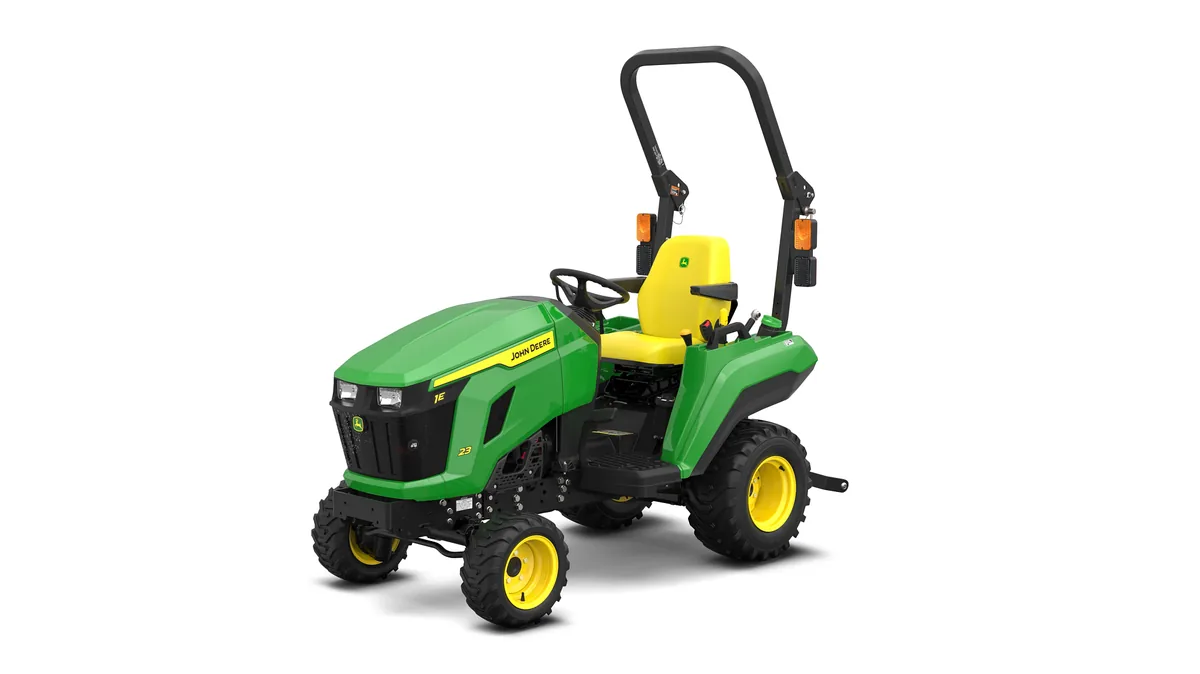
John Deere 1E 23
~$15,734dealer list, not MSRP
Sub-Compact

John Deere

John Deere 1E 23

21.5 hp engine · 16.2 PTO−25% to the shaft
Loader
803 lbs
3-pt
758 lbs
Trans
Hydrostatic
Drive
4WD

Same 21.5 hp Yanmar and same 758 lb hitch as the 1023E it replaces for model year 2027, on a simplified frame with a folding ROPS. Deere keeps this one to the essentials - no cruise control, no cab option - while the 1M 25 a step above gets both.

Spec sheet & owner notes
John Deere 1M 25
~$18,013dealer list, not MSRP
Sub-Compact

John Deere

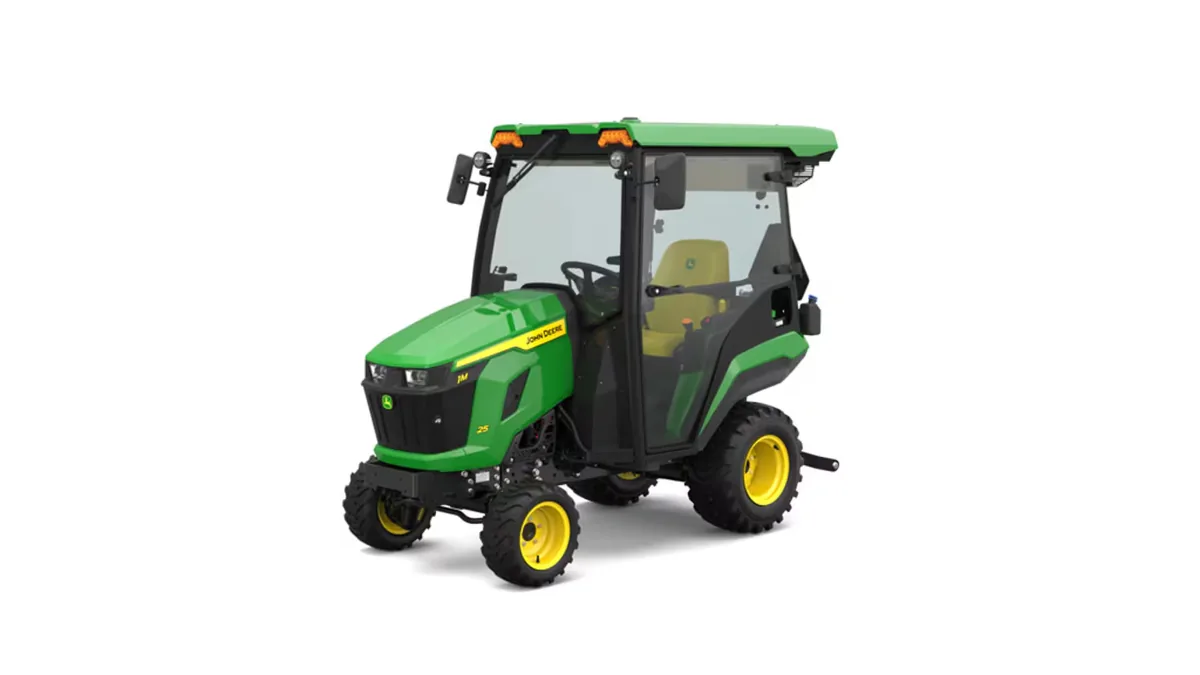
John Deere 1M 25

23.2 hp engine · 17.8 PTO−23% to the shaft
Loader
803 lbs
3-pt
758 lbs
Trans
Hydrostatic
Drive
4WD · cab

Replacing the 1025R for model year 2027, this one adds what the 1025R never offered: a factory-installed HVAC cab. Same 758 lb hitch, a 6.3 gpm pump and cruise control standard, sitting between the stripped 1E 23 and the heavier, longer 1R 25.

Spec sheet & owner notes
John Deere 1025R
~$18,764MSRP, base build
Sub-CompactNo longer built

John Deere

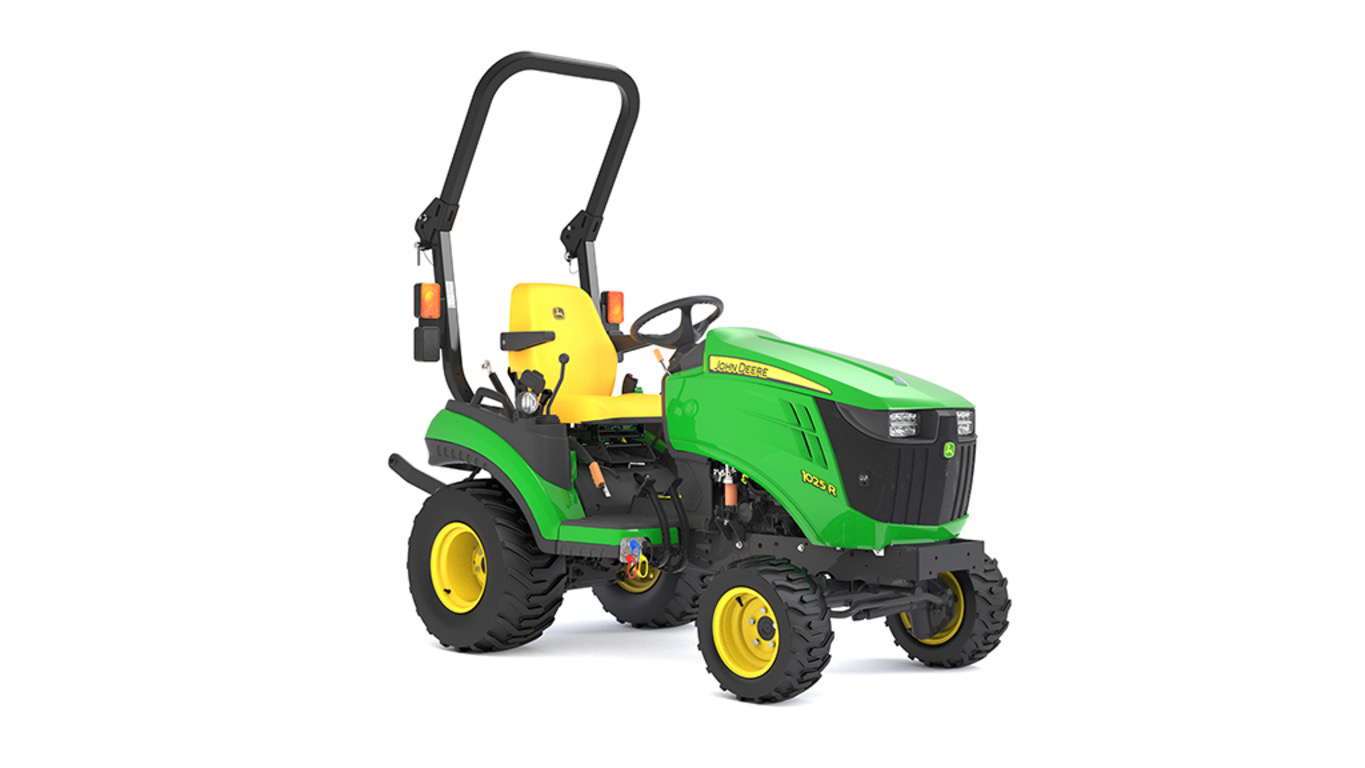
John Deere 1025R

23.9 hp engine · 18 PTO−25% to the shaft
Loader
905 lbs
3-pt
681 lbs
Trans
Hydrostatic
Drive
4WD

Best-selling sub-compact in the US, and the AutoConnect deck is most of the reason - a mower you fit and drop without leaving the seat. It continues for 2026 under the 1M 25 name, same 23.9 hp Yanmar and same 905 lb loader.

Spec sheet & owner notes