John Deere · Compact

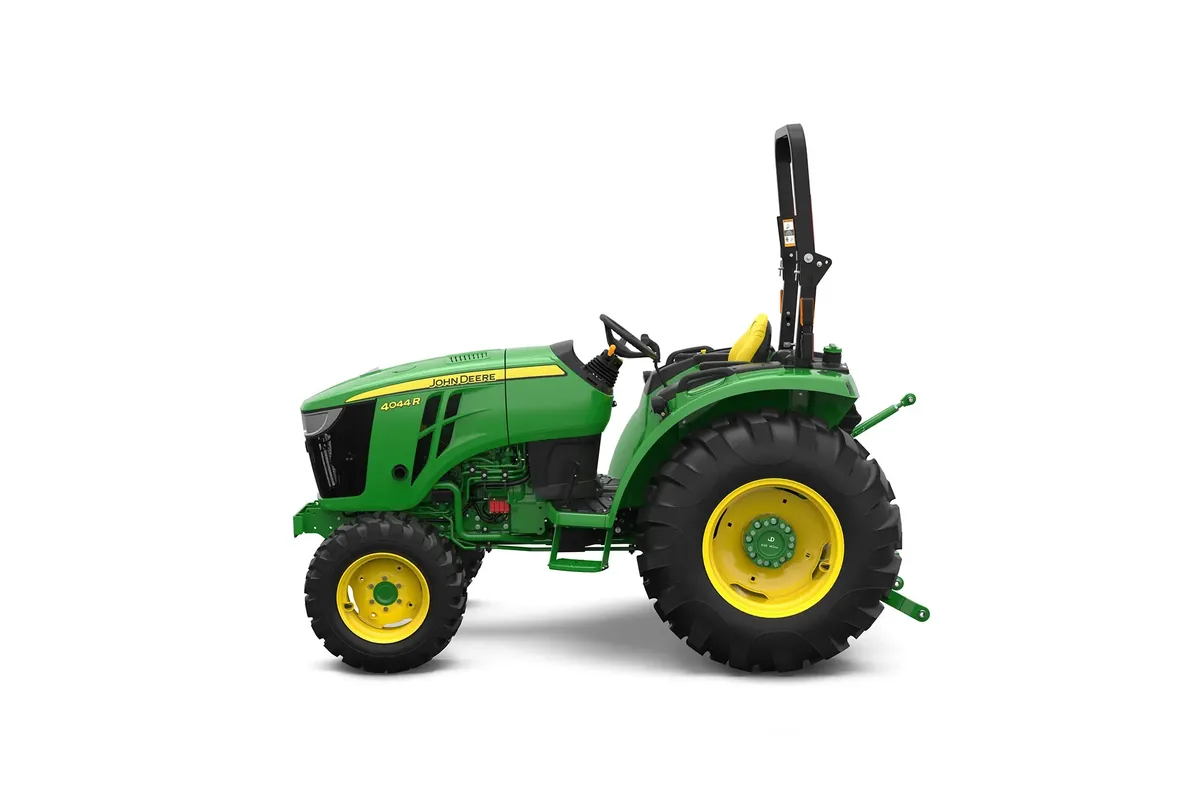
John Deere 4044R

~$40,864

MSRP, base build

John Deere 4044R
Compact
43.1 hp engine · 32.3 PTO−25% to the shaft

Cheapest way into a cab-capable 4 Family machine. eHydro is standard here rather than optional, the 440R self-levelling loader replaces the 4M's 400E, and the 2.189 L Yanmar is the only naturally aspirated engine left in the 4R line.

Engine
43.1 hp
PTO
32.3 hp
Loader lift
2,313 lbs
3-pt lift
2,500 lbs

0.79 PTO hp per $1,000 of list price

As published by the maker

Specifications

Size class
Compact
Transmission
Hydrostatic
Engine
Yanmar
Engine hp
43.1 hp
PTO hp
32.3 hp
Drive
4WD
Loader lift
2,313 lbs
Three-point lift
2,500 lbs
Hydraulic flow
17.4 GPM
Fuel tank
15 gal
Weight
3,770 lbs
Warranty
6 yr / 2000 hr powertrain
4WD
Yes
Cab
Available
Turbo
No
Cruise control
Yes

On the price: The maker's own published starting figure for the base build. A dealer adds a loader, a deck and freight on top.

Lift figures are the maker's and are quoted at whichever point the maker chose; the about page explains why two loaders with the same number do not lift the same pallet.

Comes with

4WDHydrostaticFront LoaderPower SteeringCruise ControlDieselCab

From owner discussion and long-term write-ups

What owners say

What they like

  • The 440R is mechanically self-levelling, so a loaded pallet stays flat as the boom rises - the 4M's 400E is not
  • A ComfortGard cab with heat and air conditioning is a factory option, which nothing in the 4M line offers at any price
  • eHydro with LoadMatch and eThrottle is standard equipment, and a 12F/12R PowrReverser is available instead if you prefer gears
  • 17.4 gpm total flow with a dedicated 6.2 gpm steering circuit, so the steering never starves the loader
  • Cruise control standard, useful on the long mowing passes this size gets bought for

What they complain about

  • 32.3 PTO hp with eHydro is less than a 4052M sends to the shaft while costing about $2,000 more, so the money buys the cab option and the loader, not power
  • It is the only 4R with no turbocharger, so there is no reserve under a sudden load
  • Deere's own published 440R table is internally inconsistent at maximum lift height - it prints the figure measured 500 mm ahead of the pin as higher than the figure at the pin, which is physically backwards, and two dealer reproductions repeat it verbatim
  • Fuel drops from 15 gal to 13.8 gal when you order the cab, on a machine that gains 905 lb
  • Final Tier 4 here runs both a diesel oxidation catalyst and a diesel particulate filter

Gathered from owner reports

What owners report

Three separate owners describe the same buying story: they walked into the dealership looking at the 3-series and left with this instead, and all three name it as the right call. One had planned on a 3038R and found this was a lot more tractor for not much more money; another on four acres says the higher lift capacity was the best decision he made; a third on six acres admits going slightly overkill, says it is a bit big for places his old tractor suited perfectly, and still does not regret the weight or size because hay bales are now effortless. Owners rate the machine itself highly beyond capacity too - one who has driven a lot of tractors calls it streets ahead, singling out the loader control, and reports his flawless at 80 hours.

Implement behaviour is where the reports diverge usefully. One owner runs a flail mower with a 7-foot cut and says the tractor handles it easily; another bought a 6-foot rotary cutter and finds it works only sometimes, being very easy to overwhelm and stall unless he creeps along - and notes his tractor is itself 6 feet wide, so the cutter gives him no overhang for trimming edges. Anyone moving up to one with older implements should also check driveshaft lengths first: an owner who inherited six implements with his property found the bush hog's shaft would not reach the new tractor's PTO at all. The recurring anxiety among owners is electronic rather than mechanical. One who loves his lists the engine and body control modules and the sensors on the communications bus, genuinely values what they enable - crawling the tractor forward from the rear to line up three-point implements is his example - and is frankly worried about the diagnostic and repair bill when something in that system fails, contrasting it with an old Kioti that was mechanical throughout.

What comes up favourably

  • Owners who sized up to this from the 3-series consistently say it was the right decision, citing lift capacity above all - one on four acres and another who had planned a 3038R both name it as their best choice.
  • It is pleasant to operate rather than merely capable: an owner who has driven many tractors calls it streets ahead and singles out the loader control as beautiful, reporting no faults at 80 hours.
  • A flail mower with a 7-foot cut is handled easily, according to an owner who recommends one specifically if you have gone to this size of machine.
  • Trade-in value held up well for one owner, who got 75% of what he had paid for a six-year-old smaller Deere with 164 hours when moving to a new cab model here.
  • The electronics earn their keep as well as worry people - the same owner who frets about future repair bills points to being able to crawl the tractor forward from behind while lining up a three-point implement as something he would not give up.

What comes up as a complaint

  • A 6-foot rotary cutter is at or past the limit. One owner reports his working only sometimes and stalling the tractor easily unless he travels at barely a crawl, and adds that since the tractor is itself 6 feet wide, that cutter gives him no overhang for cutting close to edges.
  • Prices have climbed steeply. An owner who paid close to $37,000 after trade-in around three years ago, on a machine then listed near $54,000, reports the same model running about $63,000 now.
  • Complexity is the thing owners fear rather than breakage. One lists the engine and body control modules and the sensors on the communications bus and says plainly that he is scared of the diagnosis and repair bill when something there goes wrong.
  • Cab air conditioning has proved awkward to diagnose on at least one used example - the owner can make the compressor clutch engage by jumping straight from the battery, has replaced all four roof relays, and still cannot get the clutch to run from the switch, with heat and blower working normally throughout.
  • Older implements may not transfer. An owner who bought one and inherited six implements with his property found the 6-foot bush hog's driveshaft was too short to reach the PTO, because everything had been set up for a much older tractor.

Questions worth asking

Should I size up to this from a 3-series?
Owners who did say yes, and they are unusually consistent about it. One had planned on a 3038R and found this was considerably more tractor for not much more money; another on four acres cites the higher lift capacity as his best decision; a third calls his slightly overkill for six acres and still would not give up the weight or size, because round bales became easy. The one caveat the third owner raises is that it is too big for a few places his previous smaller tractor handled perfectly.
What size mower will a 4044R run?
It depends on the type more than the width. An owner running a flail mower with a 7-foot cut says the tractor handles it easily, while another with a 6-foot rotary cutter finds it very easy to overwhelm and stall unless he creeps. If you want width, the flail appears the better route on this machine. Bear in mind the tractor is about 6 feet wide itself, so a 6-foot cutter leaves you nothing to reach past the wheels when trimming edges.
What is the best way to get pallet forks?
One owner laid out the three options carefully. Clip-on forks that sit in the bucket are cheapest but push the load well forward, leaving him guessing at maybe 1,000 lb of useful capacity and unable to handle a full liquid tote or a large round bale. Rear-mounted forks on a hitch receiver are more stable and cheaper again, but cannot lift high. Proper quick-attach loader forks cost several hundred to over a thousand dollars, and at that point the tractor rather than the forks becomes the limit - which is what lets you actually pick up a tote or a bale.
Is there a cheaper way to get this machine's capability?
Look at the yellow construction version. Owners point out that Deere's 110 loader-backhoe is essentially this tractor beefed up and painted for construction work, that the backhoes come off to expose a three-point hitch and PTO, and that used examples have gone for around $25,000 to $30,000 with roughly 2,000 hours - a fraction of what the equivalent green machine costs. If you want a hoe as well as a loader, that is worth pricing before you order new.

Summarised from public owner discussion, not from testing. Nothing here was measured by this site, and a report that recurs is not the same as a defect rate.

Cross-shopped against

Line the John Deere 4044R up

Same brand or same size, nearest in price

Related tractors

More from John Deere →
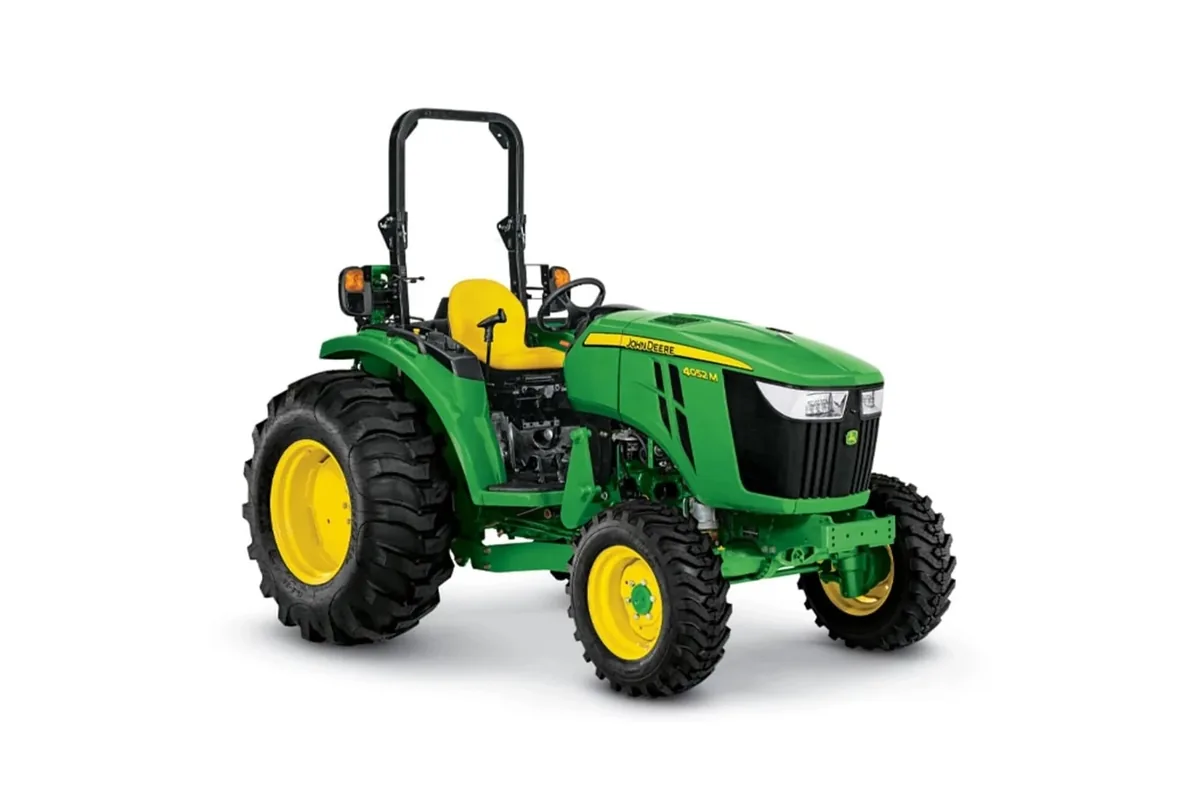
John Deere 4052M
~$40,265MSRP, base build
Compact

John Deere

John Deere 4052M

50.8 hp engine · 40.8 PTO−20% to the shaft
Loader
2,396 lbs
3-pt
2,500 lbs
Trans
Power Shuttle
Drive
4WD

Fifty horsepower with a 12F/12R PowrReverser as standard equipment rather than an upcharge, and the 400E loader that lifts 2,396 lb at the pivot pin - nearly double what the 3 Series manages. The trade is the operator station: 4M is open-station only.

Spec sheet & owner notes
John Deere 3046R
~$39,600MSRP, base build
Compact

John Deere

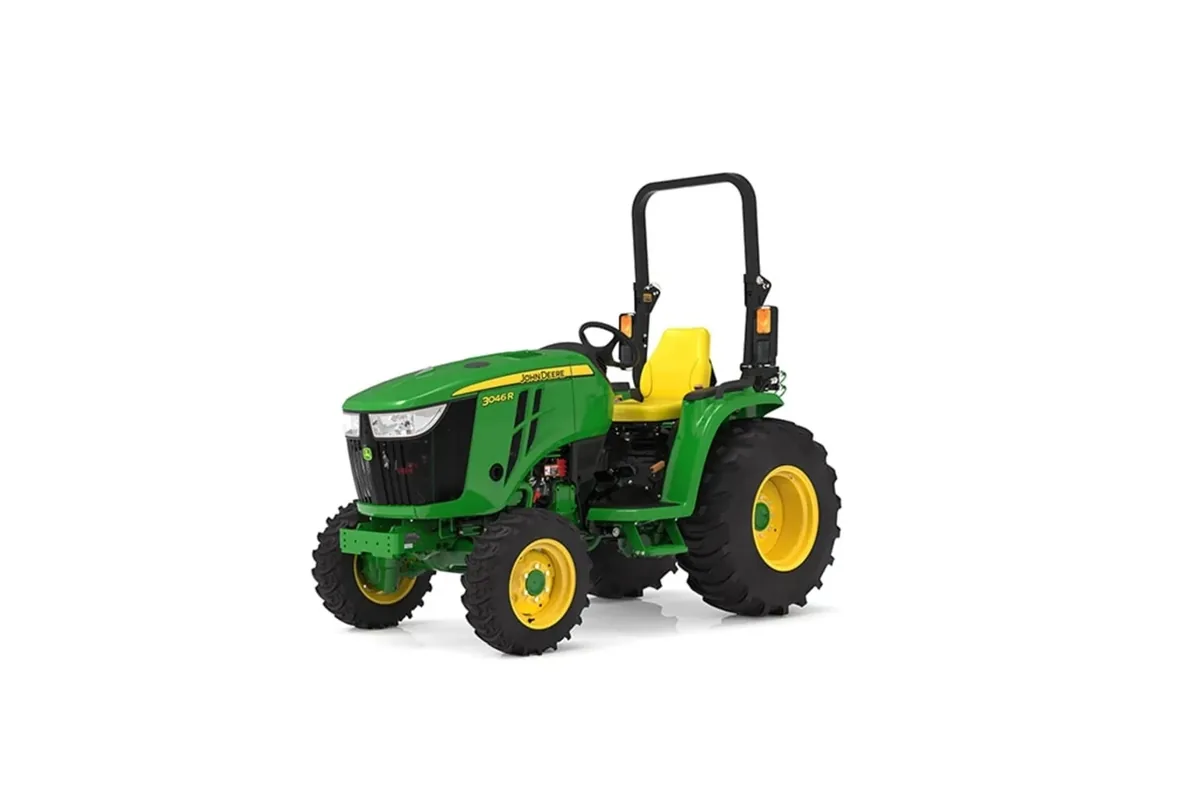
John Deere 3046R

44.7 hp engine · 33.9 PTO−24% to the shaft
Loader
1,393 lbs
3-pt
2,194 lbs
Trans
Hydrostatic
Drive
4WD · cab

The only Deere compact under 4 Family with a turbocharged, intercooled engine: 44.7 hp from 1.568 L, at the head of the 3 Series. eHydro is the sole transmission - the PowrReverser offered on the 3033R and 3039R is not on this model's order sheet.

Spec sheet & owner notes
John Deere 4052R
~$44,538MSRP, base build
Compact

John Deere

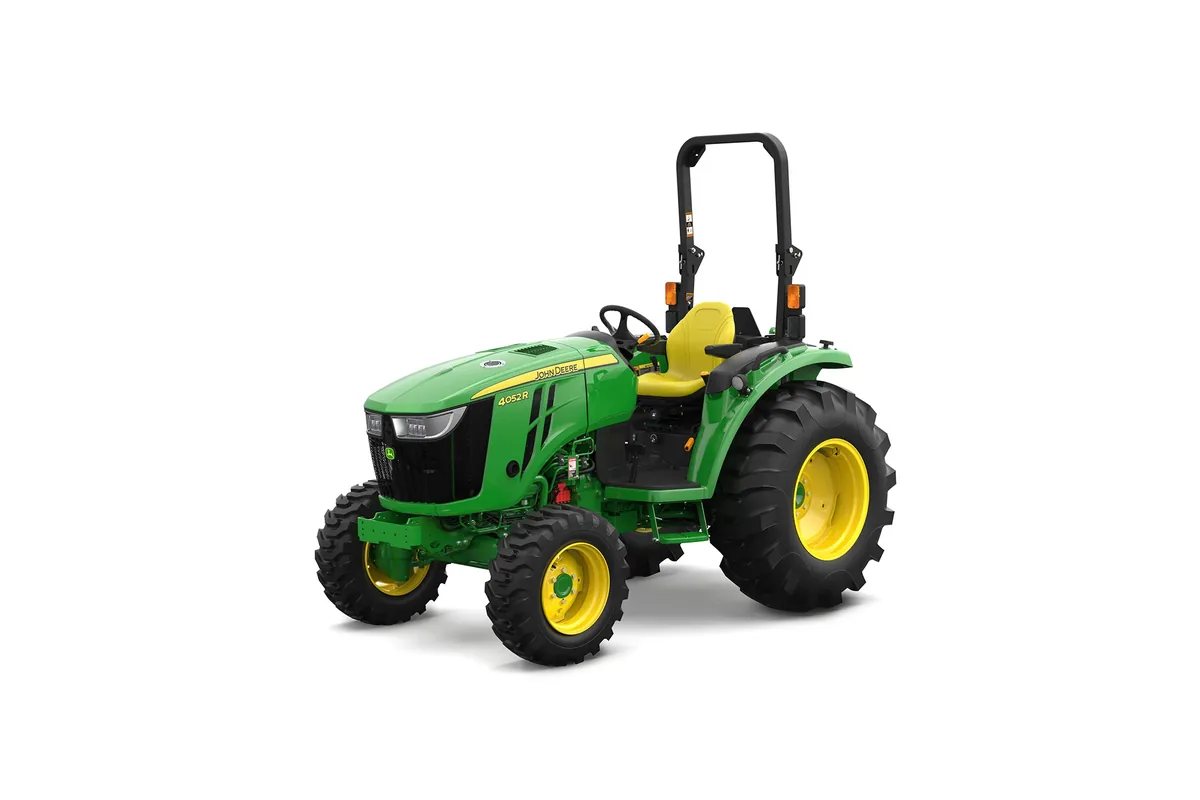
John Deere 4052R

50.8 hp engine · 39.1 PTO−23% to the shaft
Loader
2,313 lbs
3-pt
2,500 lbs
Trans
Hydrostatic
Drive
4WD · cab

Same turbocharged 2.091 L Yanmar as the 4052M, moved into the 4R chassis: eHydro standard, the self-levelling 440R loader, and a premium ComfortGard cab on the order sheet. About $5,600 buys the cab option and the better loader, not more engine.

Spec sheet & owner notes