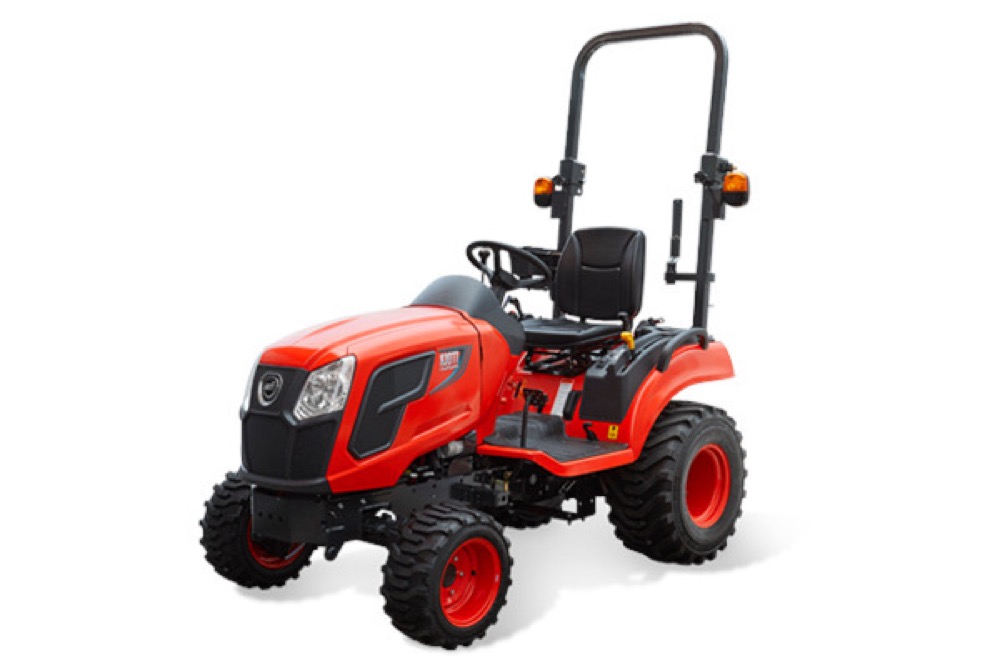
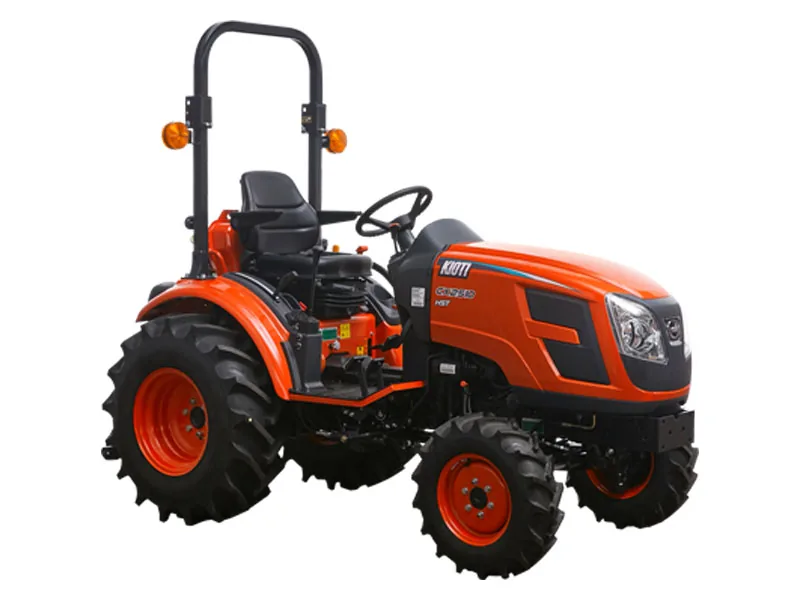
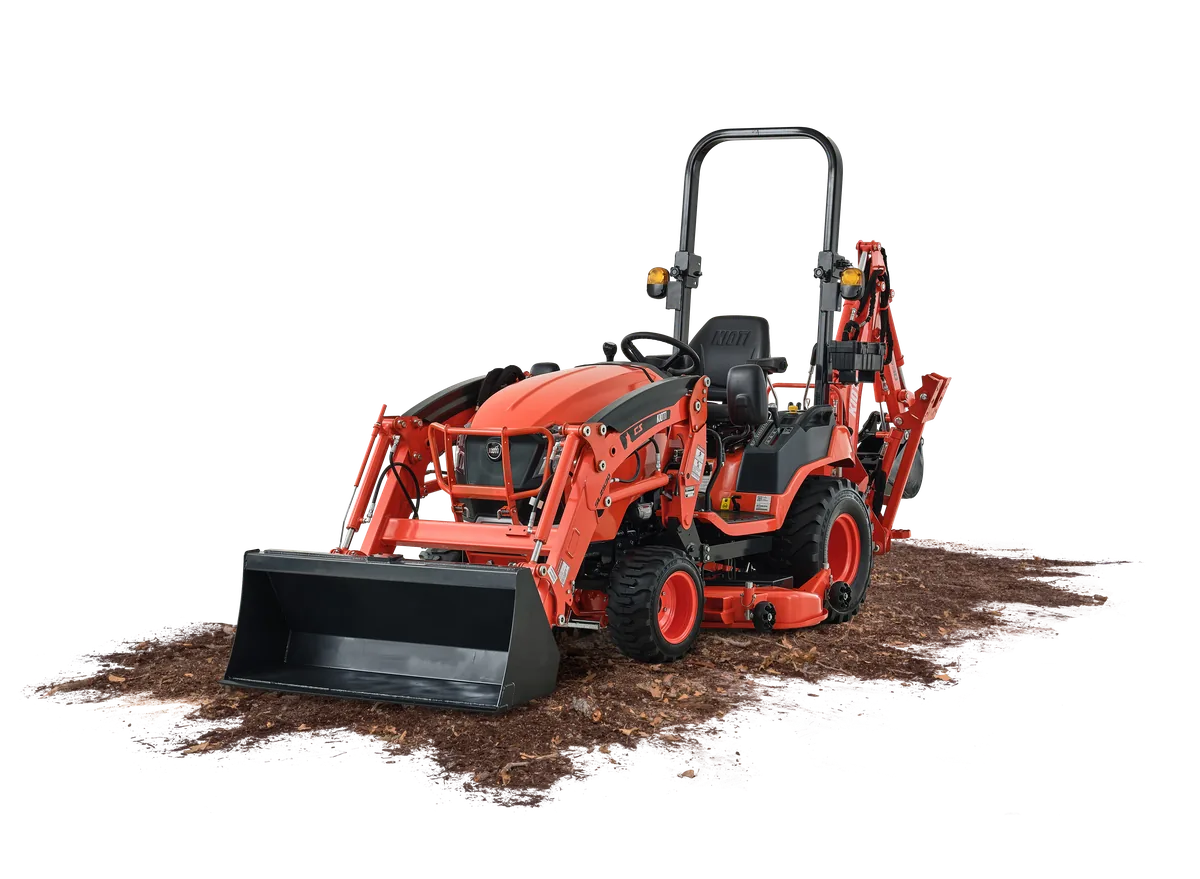
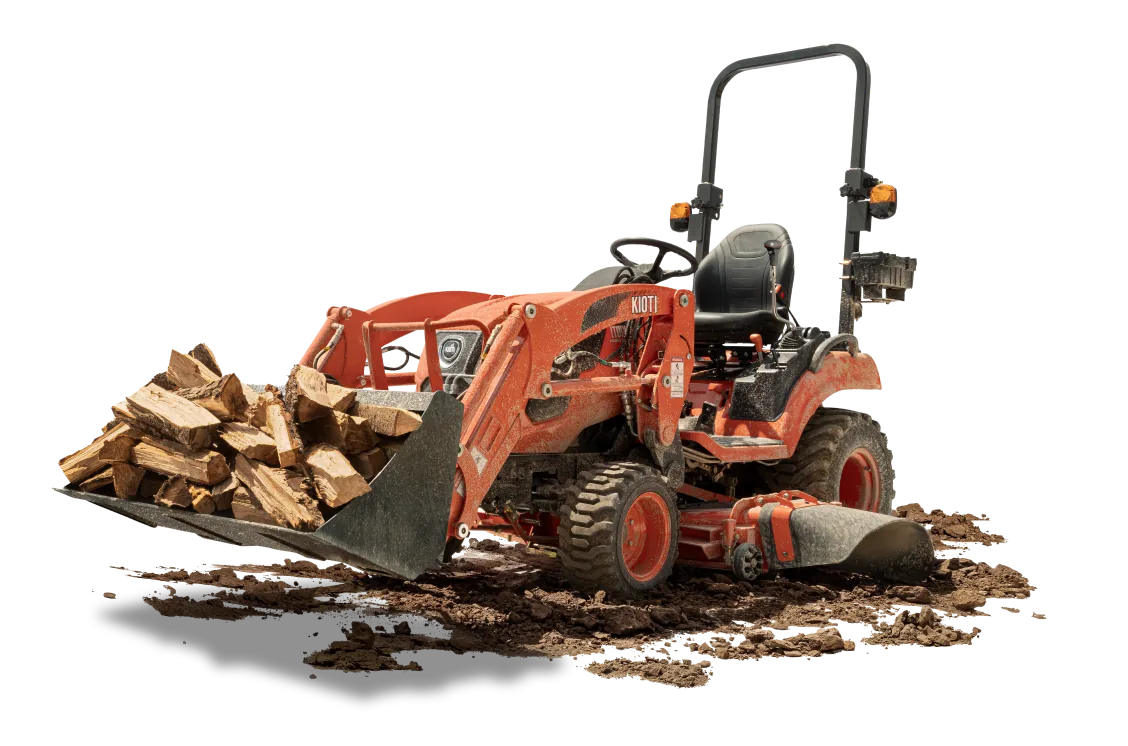
Owners disagree about this tractor's loader more than about anything else in its file, and both camps are describing it accurately. Someone whose father-in-law has put 400 hours on one mowing nine acres calls the loader weak and the tractor light — good for mowing, bad for lifting — and says it cannot move round bales and will tip forward over a bump without ballast. An owner at 200 hours who also has Kubota experience says the opposite reason is why he bought it: the front loader is significantly stronger than a BX's, and if they had been equal he would have taken the Kubota. Both are right about what the tractor is. It is a 1,554 lb machine with a loader rated well above its class, which means the limit you meet is the tractor's weight, not the loader's arms. The owner who tipped it forward was carrying a pallet of logs on forks bolted into the bucket, and his own conclusion is the useful one: bucket-mounted forks push the load a couple of feet further out than proper quick-attach forks do.
The complaint that comes up most often has nothing to do with capability. The seat safety switch is too sensitive on this model, and two owners describe the same scenario in detail — a roughly 120 lb spouse who cannot operate the tractor at all because the engine cuts out repeatedly, and a heavier owner who gets cut out when he leans forward far enough to set the brake lock. One fixed it with a bypass part costing a few dollars, which is not what anyone wants to do with a safety interlock. Beyond that the faults reported are scattered rather than systemic: a brand-new machine that leaked badly and needed three dealer visits before someone found an internal part that had been machined oversized, an hour meter that stopped counting at 108.5 hours and was not covered, a mid-mount deck that would only lift on one side.
What owners agree on is that it is a mower first and a loader tractor second, and that most people buy it for hills. Several mow steep ground with it and credit the low centre of gravity, the belly deck keeping weight low and 4WD for making slopes safer than the lawn tractor they came from. The dissent is sharp: one owner with four acres built into a 30-degree slope mowed with it once, found it too narrow and tippy even with ballast and filled tires, and went back to a steerable zero-turn while keeping the tractor for everything else. Pricing runs from about $15,000 in a dealer promotion with a loader and free delivery up to $23,000 with a loader and 60-inch belly deck, with a third function and grapple quoted around $5,000 more and a backhoe around $6,000 — and 0% financing over six or seven years is the deal owners keep naming.
Is the loader strong or weak? I have read both.+−
Both, depending on what you compare it to. Against a Kubota BX the loader is clearly stronger and that is why several owners chose it. Against what the number implies, the tractor underneath is only about 1,554 lb, so the practical ceiling is stability rather than hydraulics — one long-term owner reports it cannot move round bales and needs ballast for even light loader work. Fill the rear tires, hang something on the 3-point, and use proper quick-attach forks rather than ones bolted into the bucket, which move the load further forward.
Will the seat safety switch be a problem for a lighter operator?+−
Very possibly. Two owners report that a spouse of around 120 lb cannot keep the engine running even sitting square in the seat, and one notes the switch cuts out with no delay, so a bump or a lean forward is enough. Owners solve it with an inexpensive bypass, which works but removes a real safety function. If more than one person will drive it, sit both of them on the machine before you buy.
Can it mow a serious hill?+−
Owners split, and the split is about how steep. On rolling and moderately steep ground it is well liked — several mow hills they would not attempt with a rear-mounted deck on a bigger tractor, going up in reverse and down forwards in 4WD, and credit the belly deck for keeping weight low. On a 30-degree slope one owner found it too narrow and tippy even with filled tires and ballast, mowed once, and bought a steerable zero-turn for the mowing while keeping the tractor for everything else.
What does one actually cost?+−
Far less than the range suggests if you catch a promotion. Reported figures run from about $15,000 new with a loader and free delivery during a dealer deal, through $19,000 with loader and 60-inch deck, to $22,000 to $23,000 with the same equipment elsewhere — one owner notes he would have paid about $2,000 less in cash but took the long 0% term instead. Third function plus grapple runs around $5,000 and a backhoe around $6,000, so options move the total more than the tractor choice does.
What does the 50-hour service involve?+−
It is a full fluid and filter change rather than a top-up, and owners treat the first 50 hours as a genuine break-in period to be gentle through. One owner had his dealer do it for roughly $450 plus $150 for collection and return. If you are buying a used machine with 40-odd hours on it, ask whether that service has been done, because it is the one piece of maintenance owners consider non-negotiable.
Should I get the mid-mount deck or a separate mower?+−
Owners are split by property rather than by preference. Those with hills and less than an acre or two of grass keep the belly deck and like it. Those with more open lawn increasingly say a zero-turn or a flail cuts better and saves the repeated attach-and-remove cycle — one owner runs an inexpensive flail mower and calls it cheaper, more durable and easier to store than either a deck or a second machine. If you skip the deck, the tractor is cheaper and you keep full ground clearance.
Summarised from public owner discussion, not from testing. Nothing here was measured by this site, and a report that recurs is not the same as a defect rate.