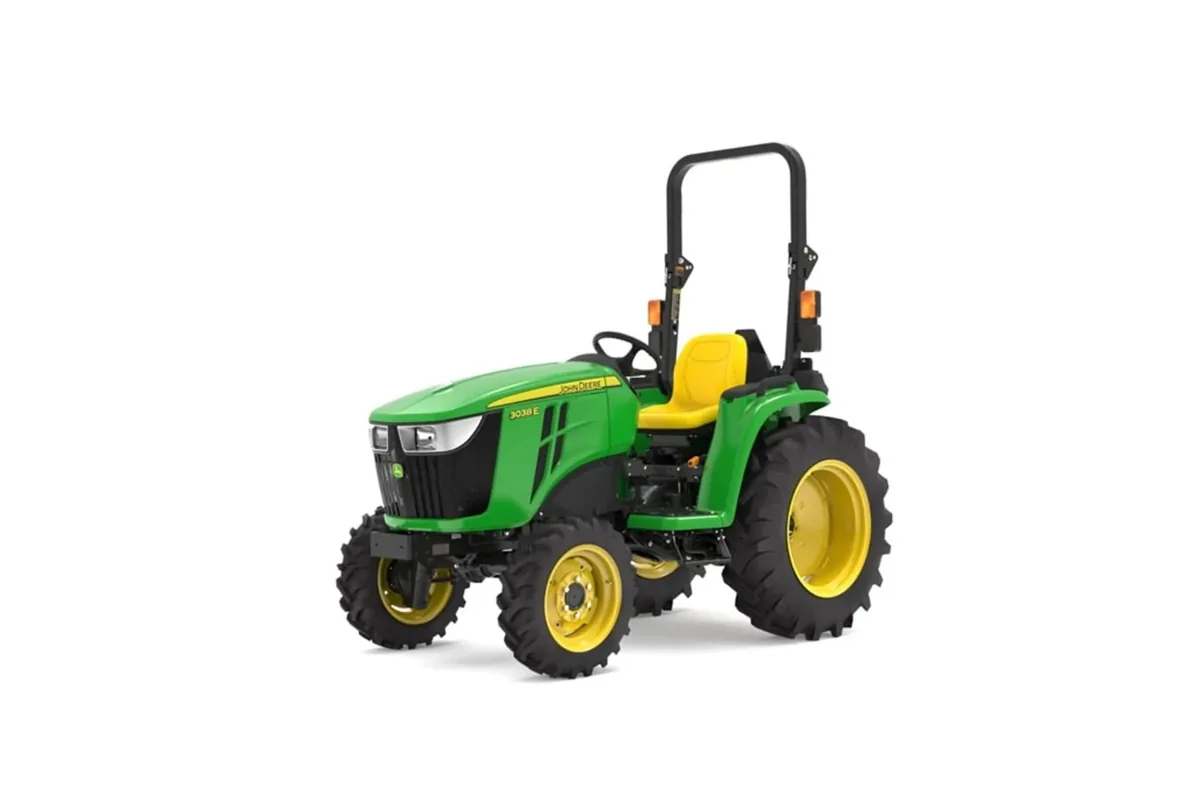
Owners are clear about which side of a line this machine sits on. One running a 5-foot flail through limbs, brush and bamboo on five acres puts it well in the camp of a work tractor rather than a big lawn mower, while noting the frame is lighter than a comparable Kubota L. That is the consistent picture: owners maintain 20 and 25 acres with a 5-foot bush hog, a box blade and a cheap three-point hitch for dragging logs, and one on 120 acres does nearly all his work within the five acres around the house. Stump grinding is the standout success - an owner with a small three-point grinder has taken out around 50 stumps at roughly ten a day, going through about 15 teeth, and says it beats renting easily, with the hydrostatic drive being what makes the constant shuffling back and forth bearable. The turbocharger is the real reason to pick this over the 3032E and it is one of the smallest turbo machines Deere sells, which owners at altitude and on hills raise specifically.
The limits are consistent and worth knowing before you order implements. It will not push trees over: owners say a healthy 3-inch tree either stalls the machine or breaks traction, and the workarounds are hooking roots with a box blade or cutting them first with a saw. Draft work is where the transmission shows up as a cost rather than a convenience - one owner reports a box blade his old 25-horsepower geared Kubota drags through anything making the hydro on this tractor whine and struggle through the same ground. Loader lift is the ceiling people bump into, though they tend to be philosophical: one who wishes it lifted more concedes the tractor would be unstable if it did, and another found spreading gravel the single job where he had to under-fill the bucket to stop it feeling tippy.
Mechanically the reports cluster in two places. The rear top-link area is the structural weak point: the rear housing is one casting, and an owner who broke his with a post-hole auger watched the crack run down it, was quoted close to $7,000 in 2013 and traded the machine rather than repair it - while another recalls one snapping a top arm winching logs. Front axles are the other, with a leak at the wheel drop losing about a quart a year in one case, and a warning that these have an unvented front axle that can build pressure, the usual remedy being an aftermarket vented dipstick. Starting and electrical faults appear across model years: a replaced instrument cluster that had stopped the intake heater grid working, a failed PTO solenoid, no-crank faults chased to relays, and a solenoid wire torn loose by a limb thrown up off the front wheel. Against that, owners rate older examples as tolerant to the point of absurdity - one that sat about a decade with no storage preparation started on a fresh battery - and the pre-emissions machines are specifically prized.
Is a 3038E enough tractor for 20 to 25 acres?+−
Owners on that exact acreage say yes, as long as the work is mowing, grading, hauling and trail maintenance rather than heavy tillage. They report a 5-foot bush hog, a box blade and an inexpensive three-point hitch attachment for dragging logs covering nearly everything, and point out you would occasionally want more tractor at any size you bought. What it is not is a machine for pushing trees over or pulling heavy ground-engaging implements all day.
Should I worry about the top link and rear housing?+−
It is the one structural weak spot owners name, and the reason is that the rear housing is a single casting rather than a bolt-on mount. One owner cracked his with a post-hole auger, watched the crack run down the casting, was quoted close to $7,000 and traded the machine rather than repair it; another recalls one snapping a top arm while winching logs. Ordinary breakage is far cheaper - a dealer-side estimate puts it at a few hundred dollars in parts plus several hundred in labour. Avoid winching or pulling from the top link.
How does the hydrostatic compare with a geared tractor for heavy pulling?+−
Poorly, and an owner who runs both is specific: a box blade his old 25-horsepower geared Kubota drags through anything makes this machine's hydro whine and struggle in the same ground. If dragging a box blade or ripping is the main job rather than loader work, owners suggest a geared tractor with R1 tires will serve you better. For loader cycles and stump grinding, where you change direction constantly, the hydro is exactly what you want.
What should I know about the front axle?+−
It comes up more than any other mechanical item on these. One owner reports a leak at the wheel drop losing roughly a quart a year, and another was told the front axle is unvented and can build pressure, with an aftermarket vented dipstick the usual remedy. It holds about a gallon of low-viscosity Hy-Gard, and owners who service their own machines treat checking that level as routine rather than something to leave until the annual visit.
What ballast and setup do owners recommend?+−
Fluid in the rear tires comes up repeatedly, both for down pressure and for steadiness under a loaded bucket. One owner pushing with R4 tires runs as little as 16 psi in the rears so the tread lays flat and grips. Beyond that, owners suggest adding a third function to the loader if a grapple is anywhere in your future, and a quick-hitch for the three point, noting the Frontier-branded one does the same job as the Deere version for less money.
Is it worth waiting for a deal on a new one?+−
Owners who track dealer stock say yes. Machines with a loader have been reported at around $27,000 to $30,000 with 0% financing where a dealer was carrying excess inventory, and the same dealer had the less powerful 3032E with a loader at roughly $25,000 a few months earlier. Because the discount depends on what an individual dealer is overstocked with rather than on the time of year, it pays to watch several.
Summarised from public owner discussion, not from testing. Nothing here was measured by this site, and a report that recurs is not the same as a defect rate.